The Fading Sound of India: Discovering the Ancient Kinnera Instrument
A few years ago I came across the Kinnera, an ancient Indian string instrument most people have never heard of. What began as small curiosity became a journey into tribal culture, history, music and storytelling — and one of the most fascinating discoveries in my research as an artist.
India has thousands of musical traditions, but some of them are quietly disappearing.
A few years ago, I came across the Kinnera, an ancient Indian string instrument that most people today have never heard of. What started as a small curiosity slowly became a journey into tribal culture, history, music, and storytelling.
As an artist, I often look for stories that inspire my work. The story of the Kinnera instrument became one of the most fascinating discoveries in my research.
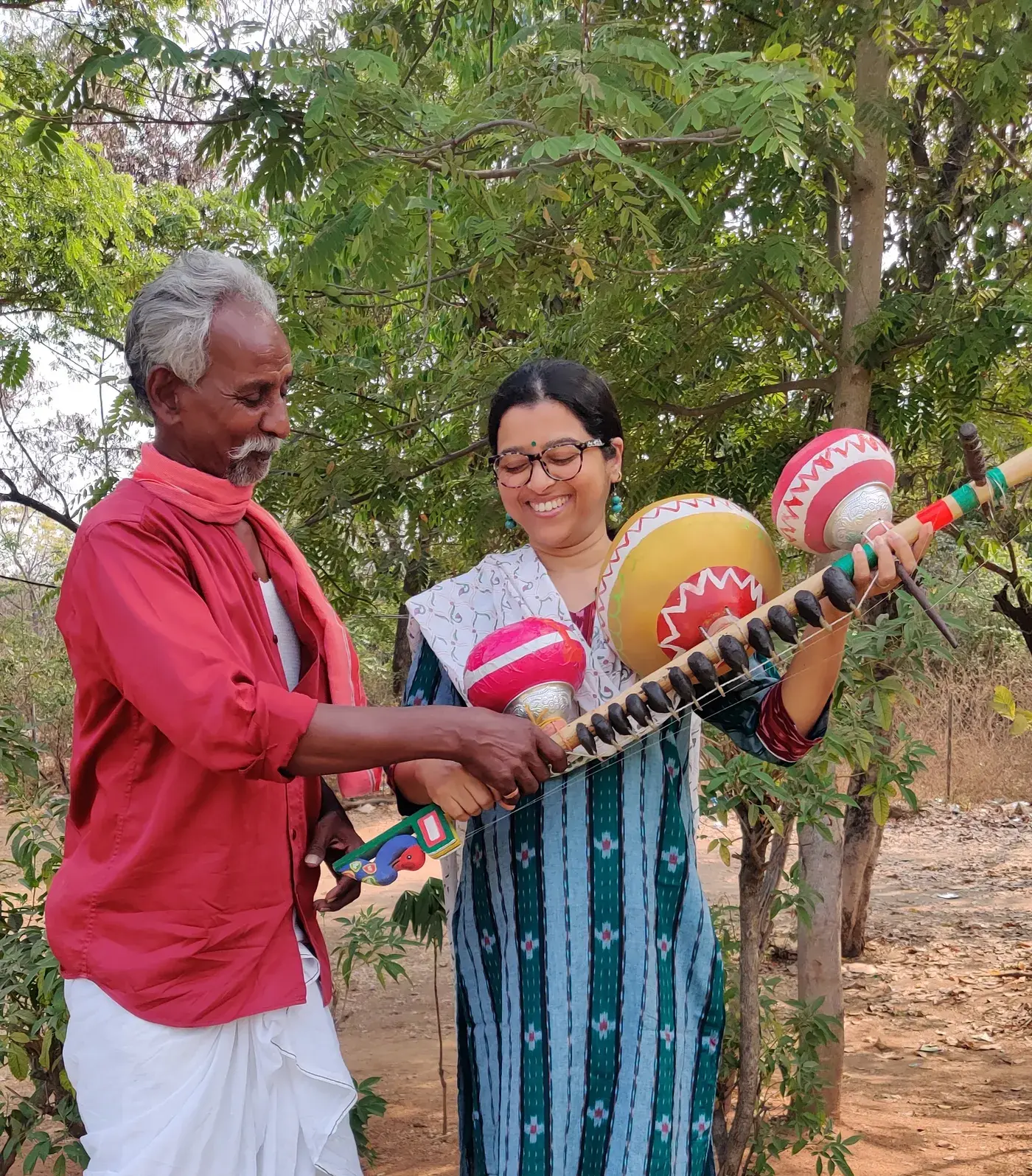
What is the Kinnera?
The Kinnera is one of the oldest string instruments found in India, traditionally played by tribal communities of the Deccan Plateau, including regions of Telangana, Andhra Pradesh, Karnataka, Maharashtra, and Odisha.
The instrument has a unique structure made from natural materials:
- —Three resonators made from dried bottle gourds
- —A long bamboo stick forming the body
- —Two strings
- —Nine to twelve frets
- —Wooden tuning pegs
The middle resonator is usually larger to create deeper resonance and a richer sound.
Earlier, the strings were made using horse hair or animal nerves, though today they are mostly replaced with steel wires.
The instrument is decorated with beads, mirrors, and sometimes peacock feathers, symbolizing Goddess Saraswati, the goddess of music.
What fascinated me most was how the instrument itself reflects the environment of the tribes who created it. Every part of it comes from nature.
A living tradition of tribal storytelling
The Kinnera is deeply connected with tribal storytelling traditions.
Communities such as the Chenchu, Dakkali, and Gond tribes have historically used this instrument to sing ballads, folklore, and stories about local heroes.
These songs are not written in books. They are passed down orally from generation to generation.
Some songs speak about farming life. Some tell heroic stories. Others describe love, festivals, and daily struggles.
Music, in these communities, is a way to preserve memory.
Why the Kinnera is slowly disappearing
Sadly, the Kinnera instrument is now considered a fading art form. There are several reasons:
- —Traditional materials like gourds and bamboo are harder to find
- —Making the instrument takes months
- —Younger generations often choose other professions
- —There are very few written records of the music
Many of the remaining artists are elderly, and the tradition survives mainly through their knowledge.
Without documentation or awareness, such traditions can disappear quietly.
Why this instrument inspired my art
As an artist, I am deeply inspired by stories that carry cultural meaning.
Learning about the Kinnera made me realize how many beautiful traditions exist outside the mainstream.
I began exploring how visual art could help tell these stories — translating music, culture, and memory into paintings.
Art can become another way of preserving heritage.
Keeping stories alive through art
India's cultural heritage is vast, but many traditions remain hidden.
By researching and documenting instruments like the Kinnera, we can create awareness and appreciation for these art forms.
Through my work, I hope to share these stories with a wider audience.
Sometimes the most powerful stories come from instruments that are almost forgotten.